CASE STUDY: MARCH 2012 – MARCH 2016
DoubleClick Search (Search Ads 360): Turning Around Enterprise Search Engine Marketing (SEM) to Reclaim #1 Market Leadership
Market Turnaround
#1 SEM Market Leader
Reclaimed 1st place in the industry with 60% YoY growth, scaling assets under management 20X over 4 years.
Revenue & Scale
Incremental Revenue
Scaled automated bidding 10X annualized run rate while earning an awarded design patent for retail inventory automation.
Role & Scope
Staff UX Lead
Spearheaded end-to-end UX for Automated Bidding, Executive Reporting (ERA), Inventory Management, and Budget Forecasting.
Overcoming algorithm distrust, reporting toil, inventory gating bottlenecks, and budget pacing blind spots at global scale.
DoubleClick Search (later rebranded Search Ads 360) had fallen from 1st to 4th place in the competitive SEM market. Enterprise search managers viewed automated bidding algorithms as opaque "black boxes," while agency analysts wasted 15 to 20 hours per week wrestling with Excel spreadsheet data dumps to compile basic executive reports.
Executive Summary
"By introducing progressive-disclosure bid portfolios, on-demand boardroom dashboards, and patented feed-driven inventory automation, we turned around DoubleClick Search to regain the #1 market leader position."
Retail advertisers with massive product catalogs struggled to manually synchronize search ad copy with shifting stock levels, demanding feed-driven automation and predictive budget trade-off modeling directly inside their workflow.

Search Ads Design Sprints & Product Excellence (Circa 2014)
Circa 2014, Google pioneered company-wide design sprints that gathered all designers working across Ads to establish early product excellence initiatives that remain central to Google's UX culture today. Working in high-velocity, scrappy sprint loops, our team capitalized on massive market opportunities through relentless hard work—ultimately transforming Search Ads into a multi-billion-dollar revenue engine.
Project Goals & Strategic Focus
Incentivizing Bidding Automation Adoption
Scale Performance Bidding Suite (PBS) adoption by demystifying algorithmic bidding, scaling automated spend to a 10X annualized run rate.
Capturing Upper-Funnel via Attribution
Introduce non-last-click attribution modeling so advertisers can justify and protect investments in generic keywords, display, and YouTube touchpoints.
Growing Retail-Managed Spend
Launch inventory-aware bidding and ad templating linked to Merchant Center feeds, generating millions in annual incremental revenue by syncing ad state with stock.
Unblocking Spend via Bid Forecasting
Provide bid strategy forecasting and preview tradeoff charts to reduce predictability fears, prompting 30% of target customers to optimize budgets directly in UI.
Deconstructing automated bidding barriers, executive reporting workflows, and feed-driven inventory automation.
Rapid Iterative Testing and Evaluation (RITE) uncovered core pain points across four foundational Search Engine Markeing (SEM) operational areas.
Automated Bidding: The "Black Box" Barrier
Advertisers distrusted opaque bid algorithms and faced setup complexity overload. Designing progressive-disclosure goal setups (brand exposure, clicks, revenue) coupled with non-last-click attribution built trust and unblocked upper-funnel keyword spend.
Executive Reporting: 20-Hour Excel Toil
Agency analysts spent up to 20 hours weekly compiling cross-engine data dumps (Google, Bing, etc). Creating an on-demand dashboard suite with custom logos, annotations, mixed charts, and recurring email schedules provided a sanity-saving boardroom prep tool.
Inventory Management: Feed-Driven Automation
Massive retailers couldn't keep pace with inventory changes via spreadsheet uploads and downloads. Walkthroughs validated inventory ad templates that inject feed variables and calculate dynamic max CPC bids, automatically pausing ads on zero inventory.
Budget Forecasting: Active Management vs. Monitoring
Legacy pacing utilities offered passive monitoring without adjustment advice. Users demanded predictive cost-to-conversion tradeoff charts and inline daily budget adjustment controls directly within their campaign pacing views.
Harmonizing portfolio bid optimization, executive reporting dashboards, dynamic inventory ad campaigns, and predictive budget pacing across core SEM workflows.
Structured Use Cases empowered enterprise search marketers to effortlessly automate bids, generate instant executive reports, sync product catalogs, and forecast budget tradeoffs.
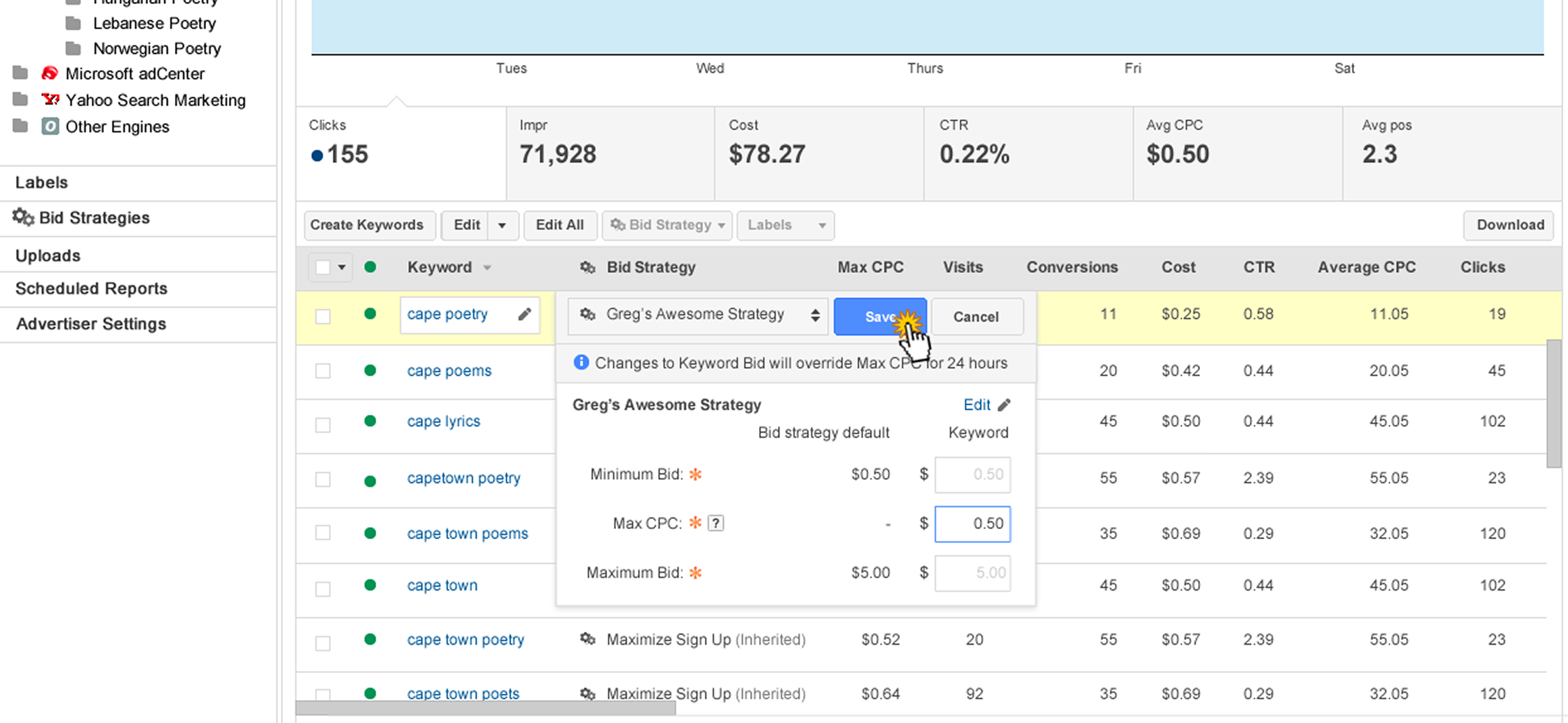
Automated Bidding & Portfolio Optimization
Advertisers define high-level KPI goals (brand exposure, clicks, ROAS/ERS) via progressive disclosure, review contextual enhanced campaign recommendations in bulk across millions of keywords, and enable non-last-click portfolio attribution.
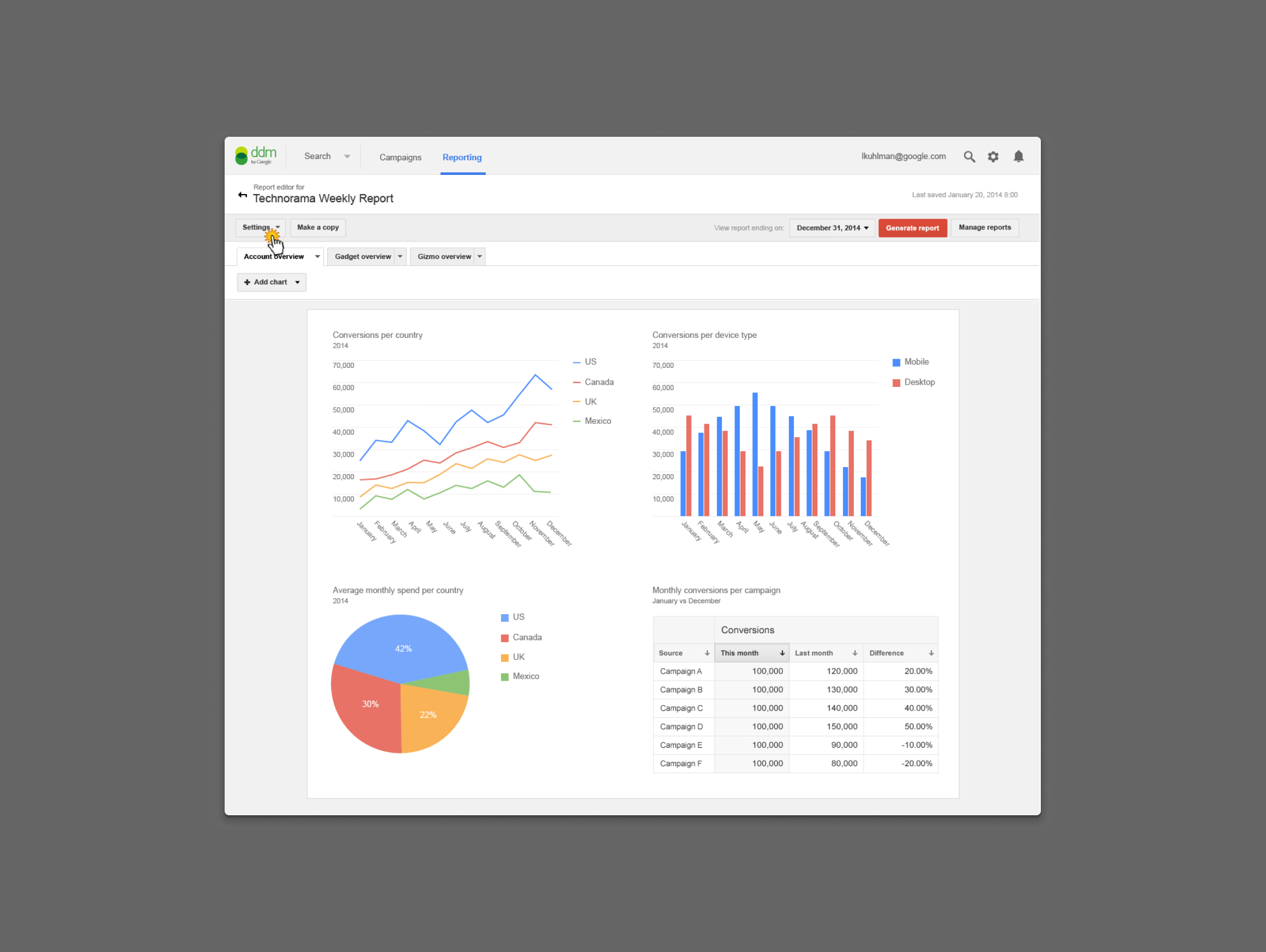
Executive Reporting & Boardroom Dashboards (ERA)
Agency directors instantly compile cross-engine performance across Google, Bing, and Yahoo into polished, branded client reports equipped with custom pivot tables and manual performance annotations.
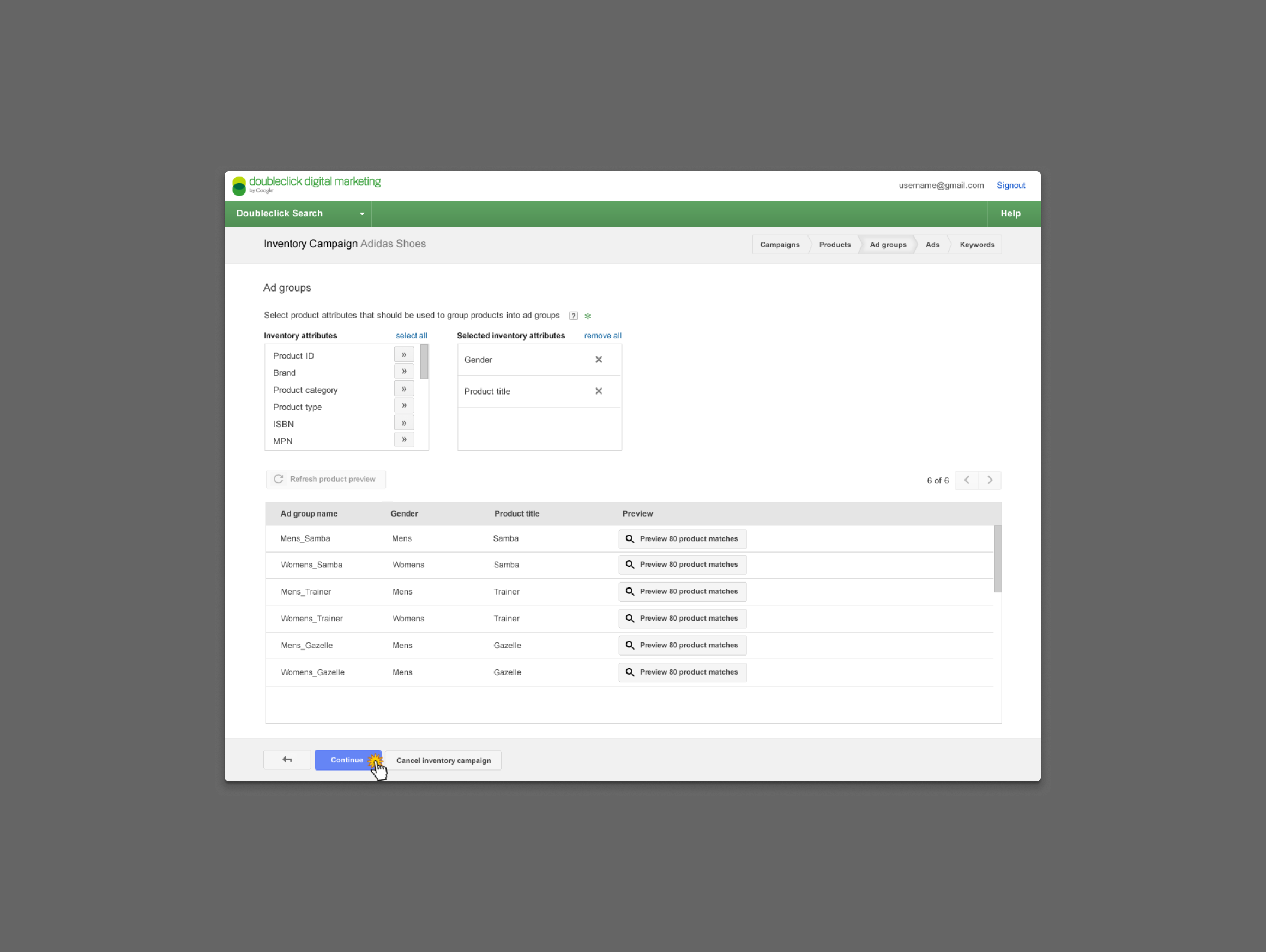
Feed-Driven Retail Inventory Management
Retail marketers link Google Merchant Center feeds to automatically generate campaigns, utilize dynamic ad copy templates and margin-based target CPC functions, and enforce margin safety rules pausing sold-out SKUs.
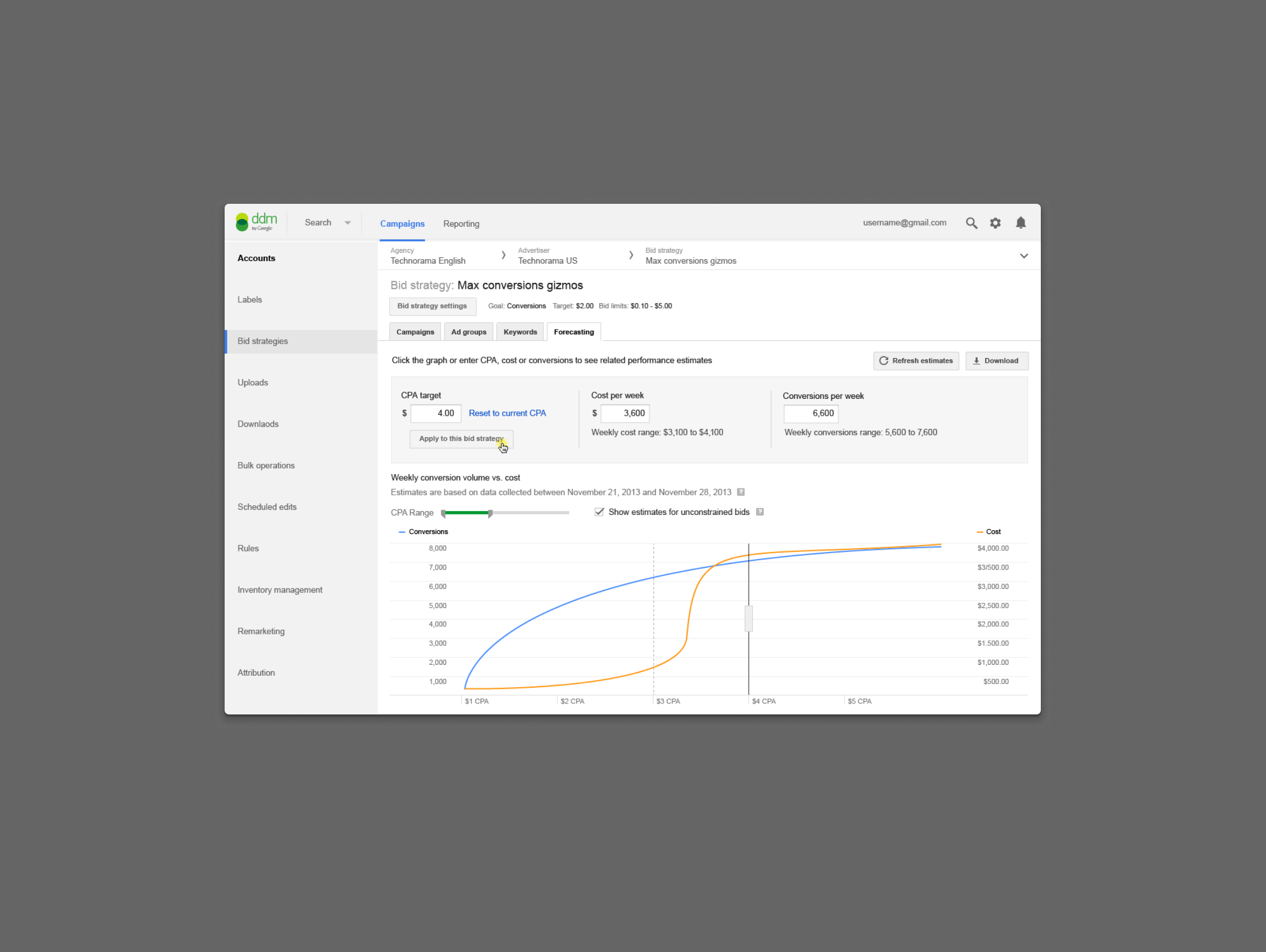
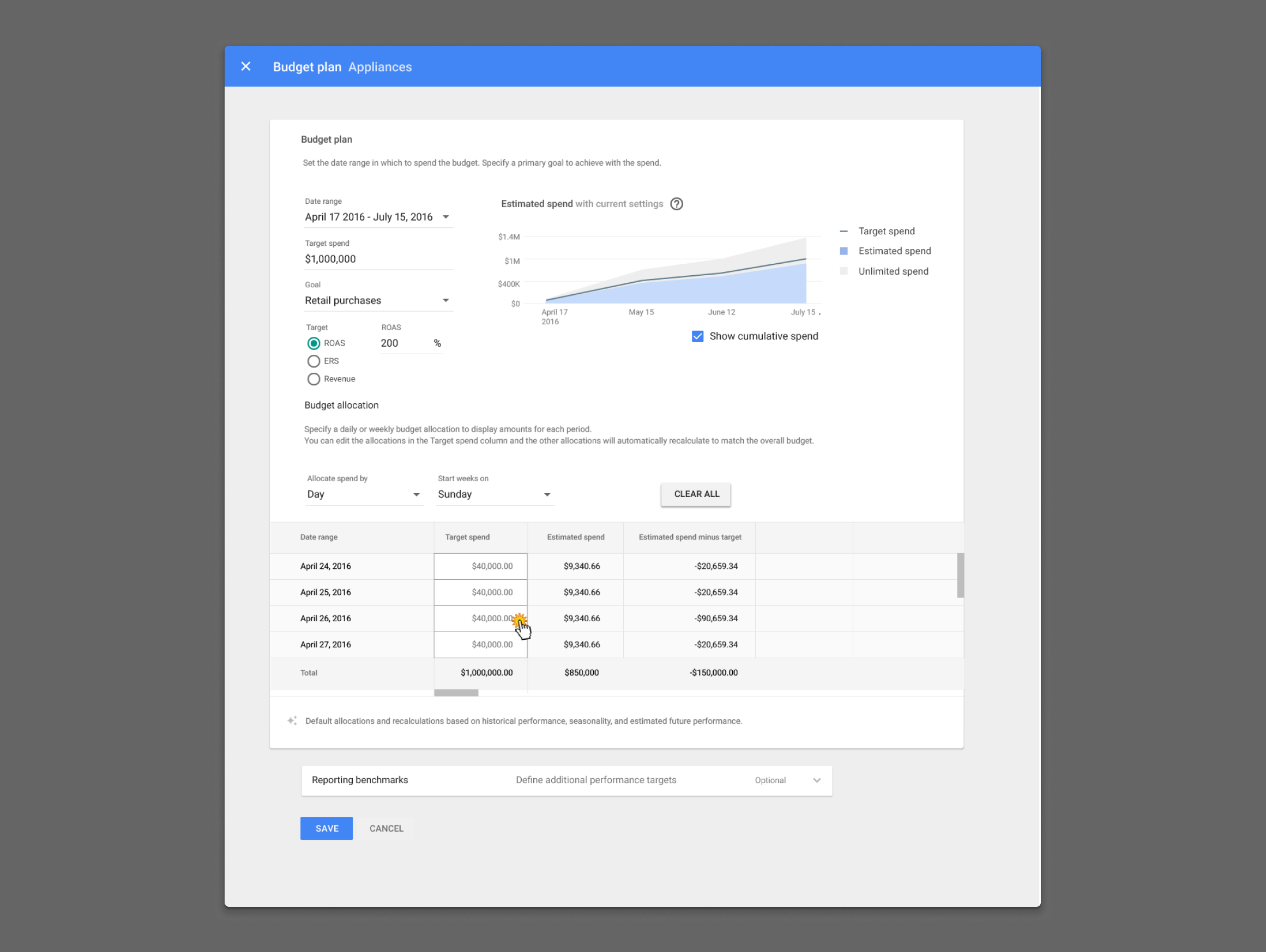
Predictive Budget Forecasting & Pacing
Advertisers evaluate cost-to-conversion tradeoffs on predictive forecasting charts, monitor active media run rates, and adjust daily campaign budgets inline on a single unified screen.
Raising Capital & Accelerating Revenue for Google
UX leadership directly accelerated Google's ad revenue trajectory, unlocking massive incremental AdWords spend and tripling feature adoption by redesigning attribution models to protect upper-funnel brand investments.
Results
- Unlocking 12% Incremental Spend: Agency onboarding and validation frameworks increased AdWords spend by ~12% for new advertisers, generating hundreds of millions in annual incremental revenue.
- Tripled Attribution Adoption: Redesigning bidding workflows to integrate non-last-click attribution tripled feature adoption from ~15% to 40% of managed spend.
- Exponential Bidding Scale: Performance bidding suite overhauls quadrupled optimized daily advertising spend.
Transforming Workflow and ROI for Advertisers
The platform overhaul eliminated thousands of hours of administrative reporting toil across agencies, secured an awarded design patent for feed-driven retail automation, and unblocked massive cross-engine bulk editing.
Results
- Drastic Reporting Time Savings: Executive Reporting (ERA) eliminated 12 to 15+ hours weekly of manual Excel toil per analyst, supporting billions in reported spend by EOY.
- Portfolio Management Efficiency: Applying bid strategies at campaign/ad group levels rather than individual keywords saved search managers 5 to 12 hours weekly.
- Patented Retail Growth: Feed-linked inventory templates generated millions in annual incremental client revenue with 171% higher ROAS, securing an awarded design patent.
- 100,000 Bulk Operations Daily: Unblocked cross-engine bulk editing allowed agencies to maintain identical Google and Bing structures seamlessly.
Recognition as Critical Corporate Achievements
The successful product turnaround propelled DoubleClick Search back to the industry's #1 leadership position, earning explicit executive recognition from Google's Board of Directors and senior product leadership.
Results
- Regaining #1 Market Leadership: VP Sridhar Ramaswamy announced DCS officially regained the #1 Seach Engine Marketing (SEM) market position (surpassing Marin) with 60% YoY growth.
- Executive Board Recognition: Turnaround highlighted during Eric Schmidt's Board of Directors meeting as Google's #1 Search Marketing tool.
- Key Corporate Milestones: Celebrated as a Top 10 Ads Accomplishment in Q4 2013, with foundational rebuild tracked as a strategic company OKR.
Empowering the Next Generation of Enterprise Search Marketing
The transformation of DoubleClick Search established modern Search Ads 360 standards—empowering agencies to automate bids, streamline boardroom reporting, and manage billions in global ad spend.